Discovering Symmetry Groups with Flow Matching

1Northeastern University, 2University of Amsterdam, 3University of California San Diego
*Equal Contribution
International Conference on Machine Learning (ICML) 2026

Abstract

Symmetry is fundamental to understanding physical systems and can improve performance and sample efficiency in machine learning. Both pursuits require knowledge of the underlying symmetries in data, yet discovering these symmetries automatically is challenging. We propose LieFlow, a novel framework that reframes symmetry discovery as a distribution learning problem on Lie groups. Instead of searching for the symmetry generators, our approach operates directly in group space, modeling a symmetry distribution over a large hypothesis group $G$. The support of the learned distribution reveals the underlying symmetry group $H \subseteq G$. Unlike previous works, LieFlow can discover both continuous and discrete symmetries within a unified framework, without assuming a fixed Lie algebra basis or a specific distribution over the group elements. Experiments on synthetic 2D and 3D point clouds, ModelNet10, and a real-world MI-Motion dataset show that LieFlow accurately discovers continuous and discrete subgroups, significantly outperforming a state-of-the-art baseline, LieGAN, in identifying discrete symmetries.

Introduction

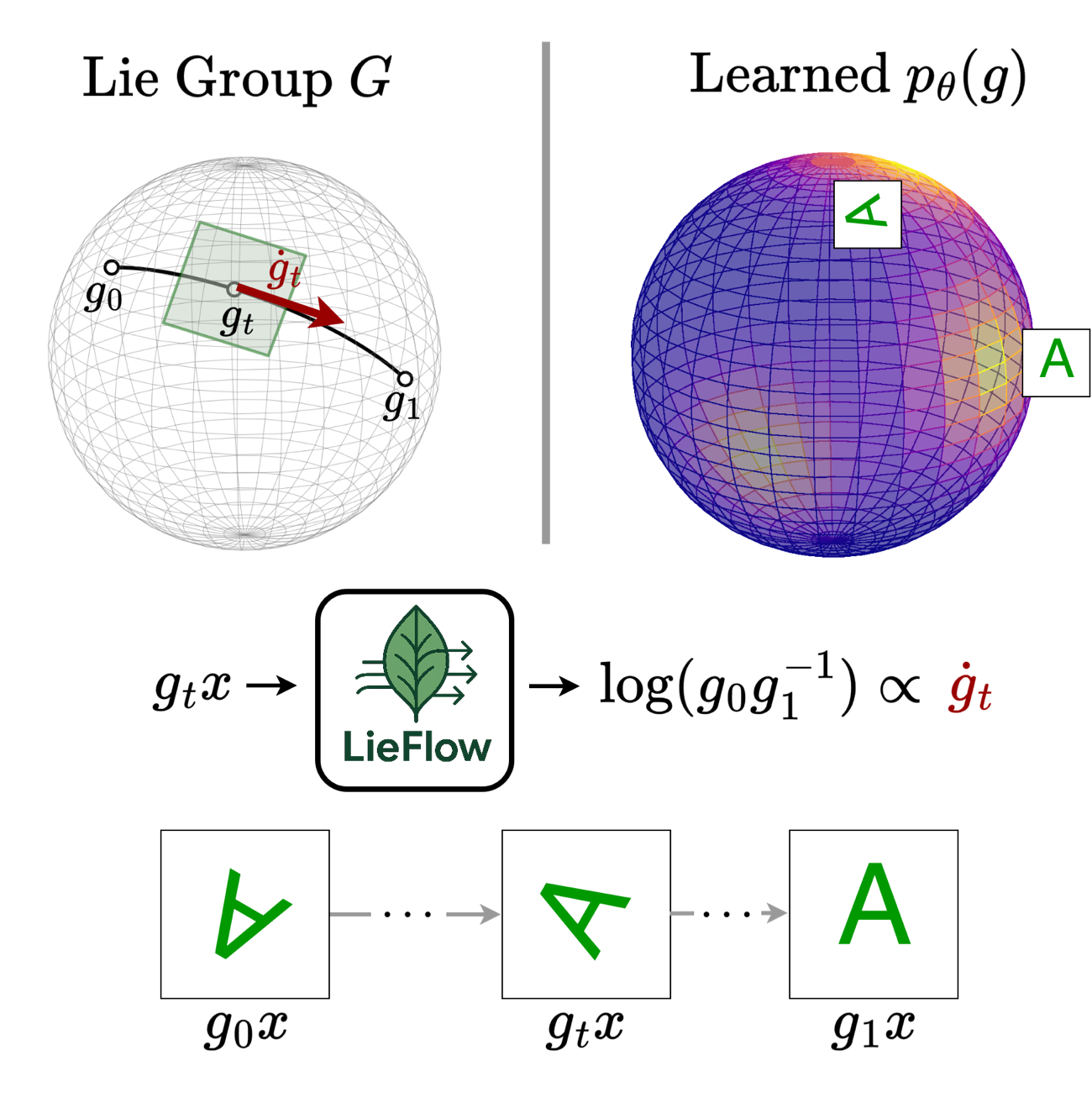
LieFlow overview: learning a distribution of transformations over a hypothesis Lie group via flow matching.

Goal. Discover unknown symmetries of a dataset automatically.

Key idea. Learn a probability distribution over a hypothesis Lie group $G$ by flow matching directly on the group, with a power-law time schedule to capture higher-dimensional groups. The support of the learned distribution reveals the true symmetry subgroup $H \subseteq G$.

Takeaway. The LieFlow framework recovers both continuous and discrete symmetries, outperforming baselines such as LieGAN, SGM, and Augerino, especially on discrete groups.
Results

Synthetic 2D: recovering $C_4$

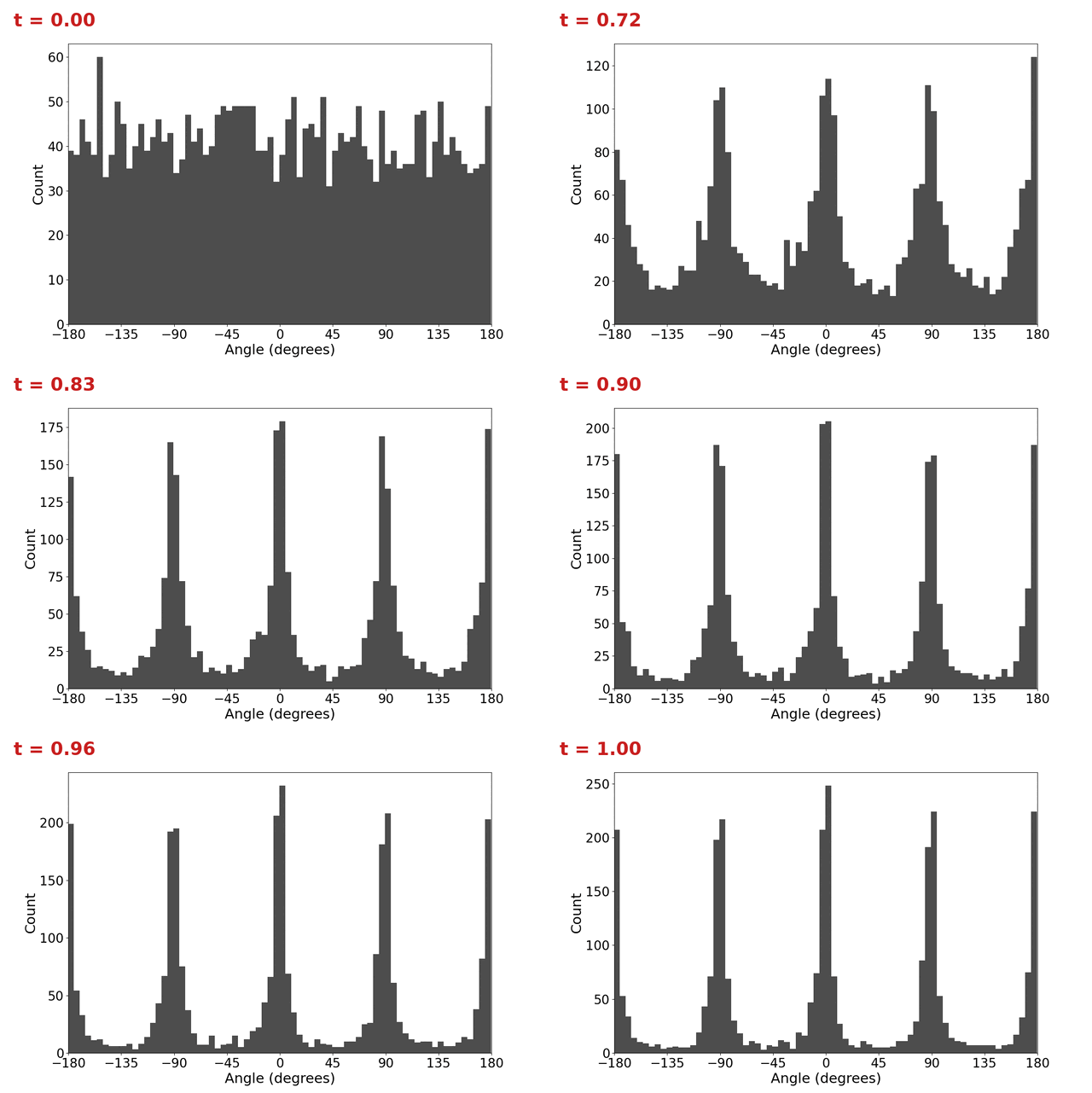
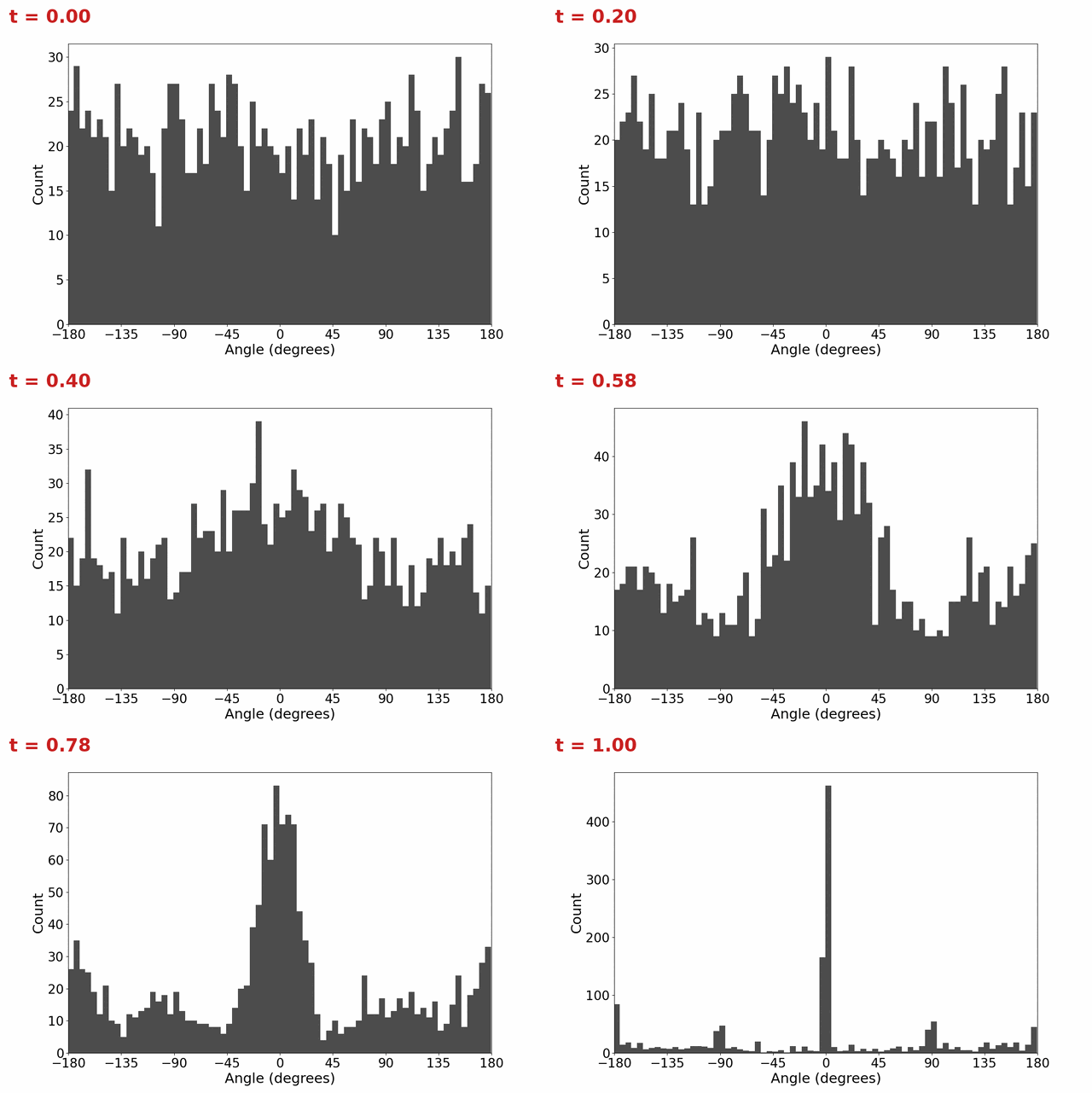
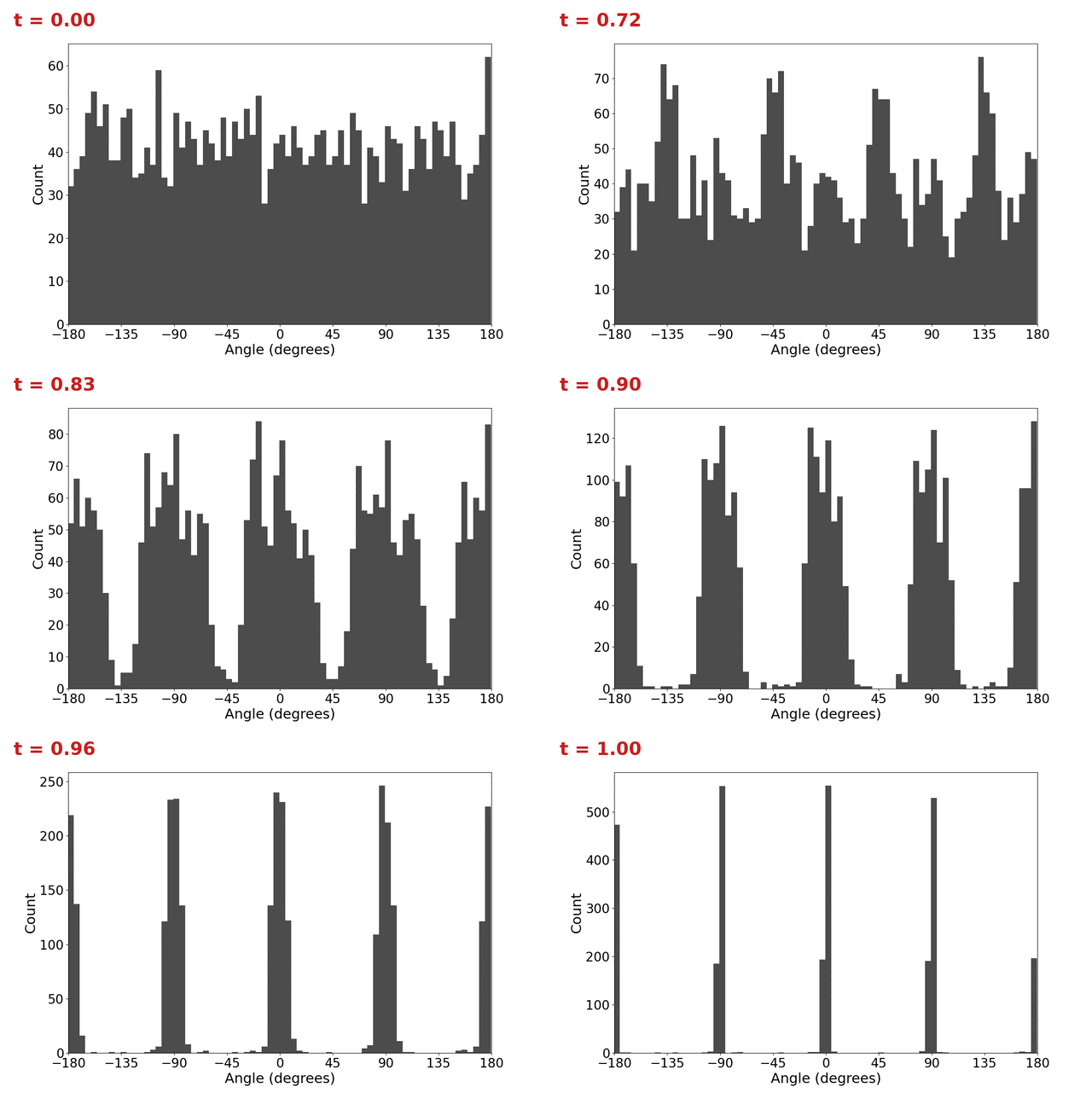
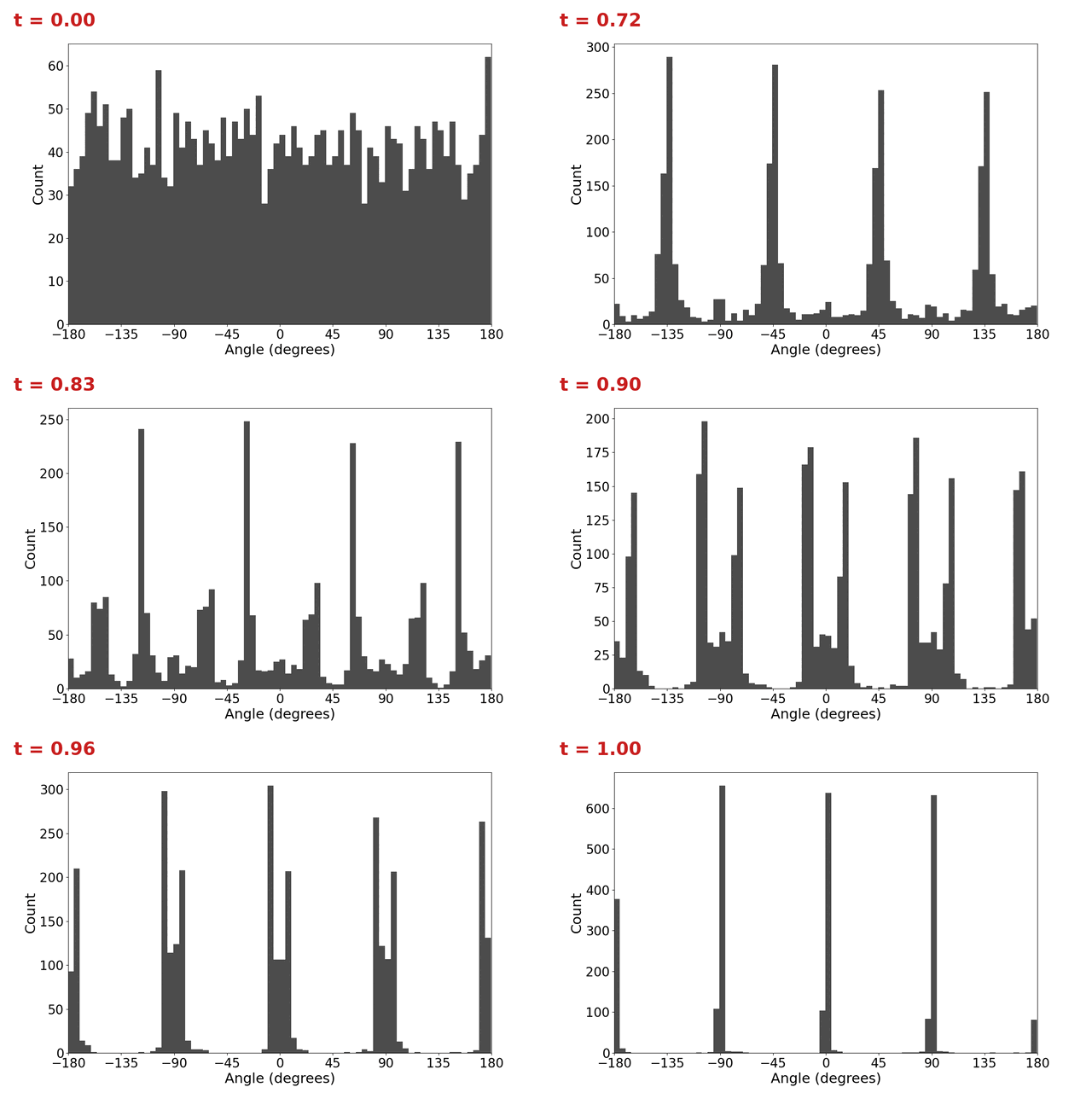
On synthetic 2D point clouds, we evaluate LieFlow with a compact hypothesis group $\mathrm{SO}(2)$ and a non-compact $\mathrm{GL}(2,\mathbb{R})^{+}$ (two priors). The learned angle histograms peak at the four $C_4$ elements, showing that LieFlow recovers the symmetry in every setting and beats LieGAN on Wasserstein-1 (e.g., $0.054$ vs. $1.07$ for $\mathrm{SO}(2)\!\to\!C_4$).

SO(2) to C4 angle histogram over flow time

$\mathrm{SO}(2)\to C_4$

GL(2) to C4, Lie algebra sampling

$\mathrm{GL}(2)\to C_4$ (Lie algebra)

GL(2) to C4, matrix sampling

$\mathrm{GL}(2)\to C_4$ (matrix)

Synthetic 3D: subgroups of $\mathrm{SO}(3)$

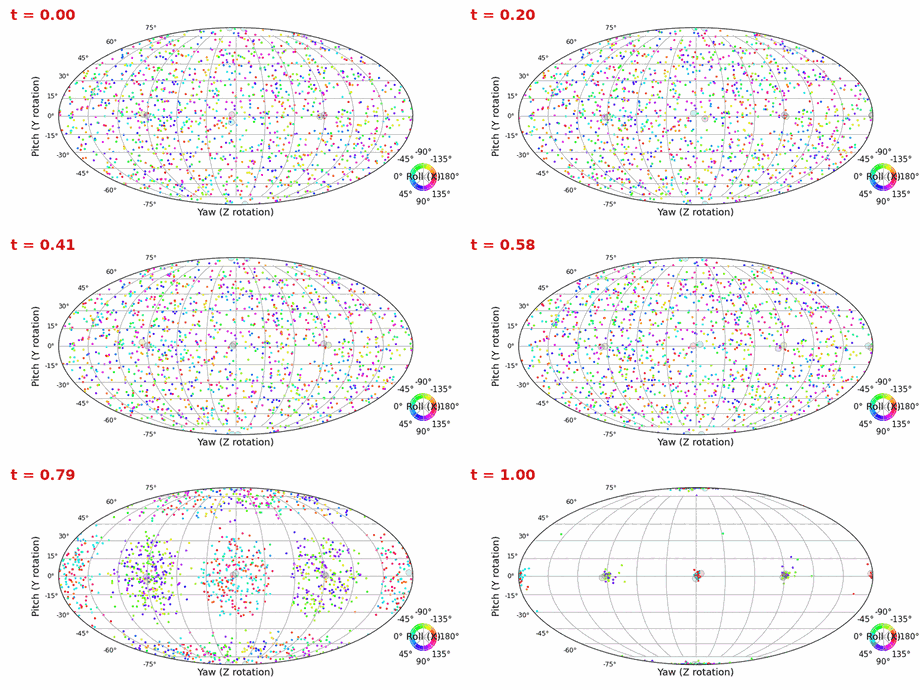
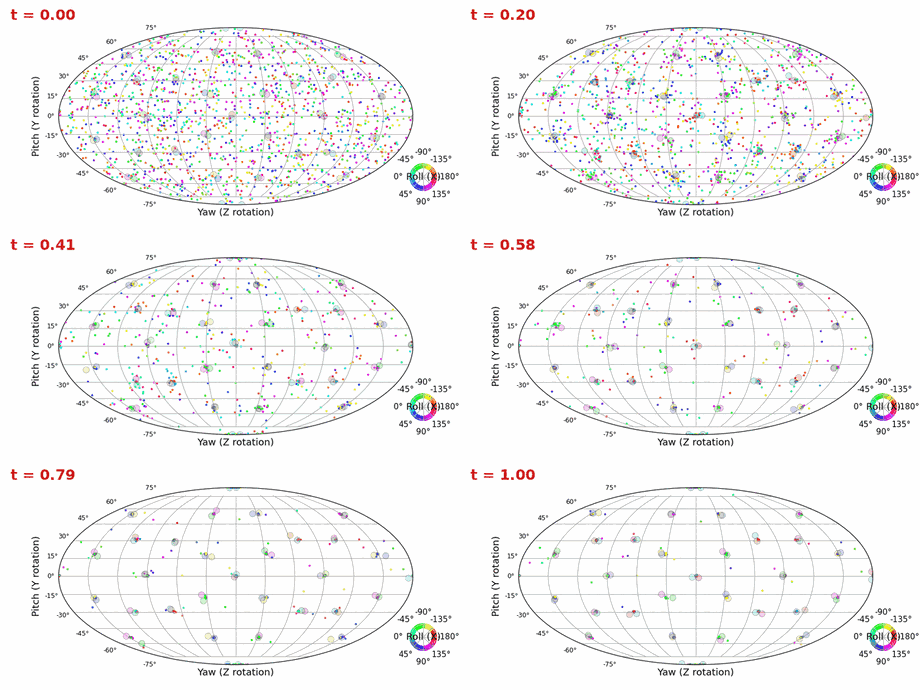
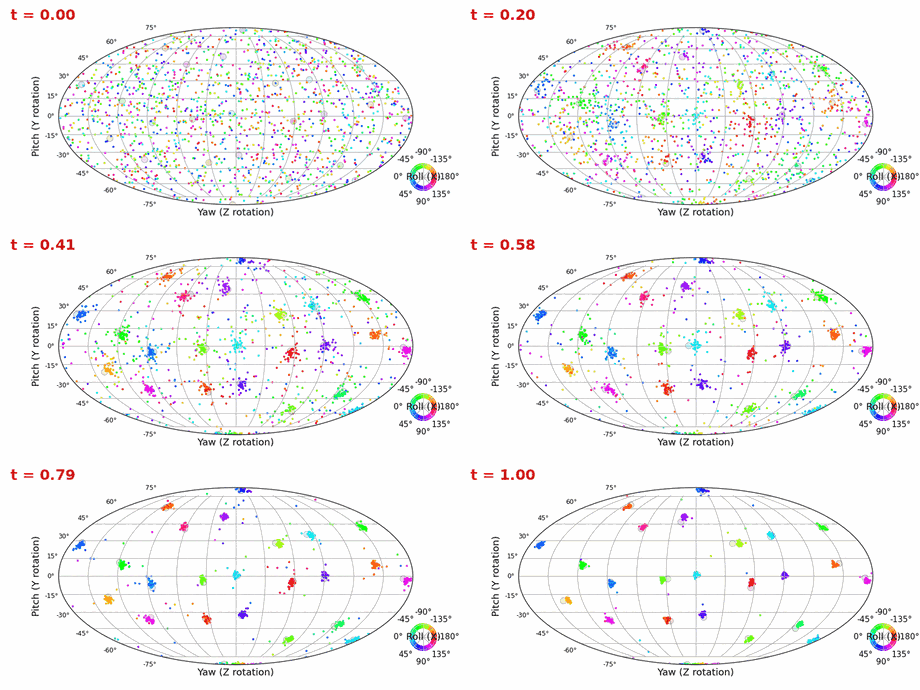
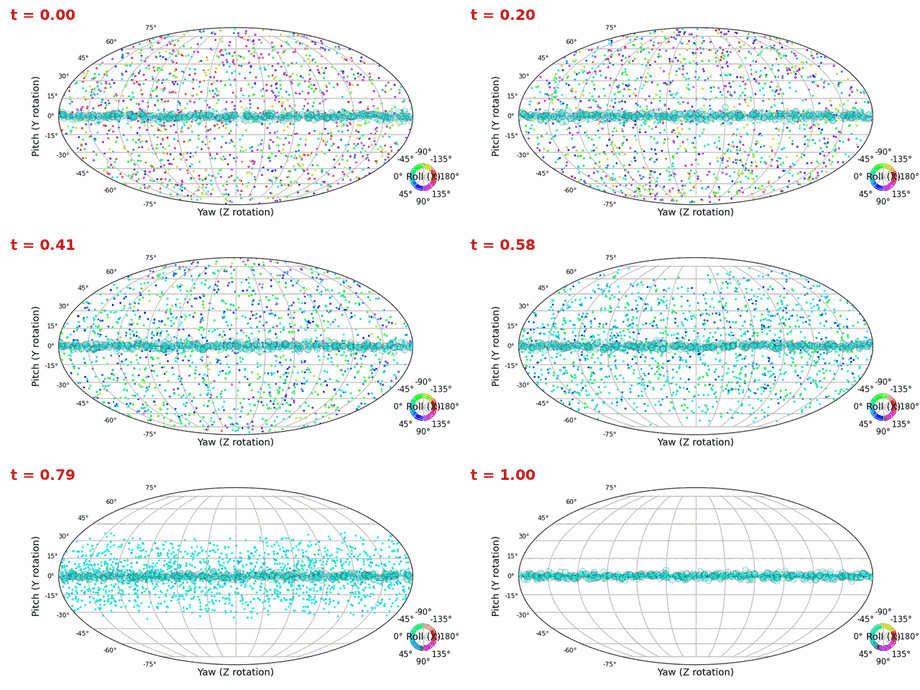
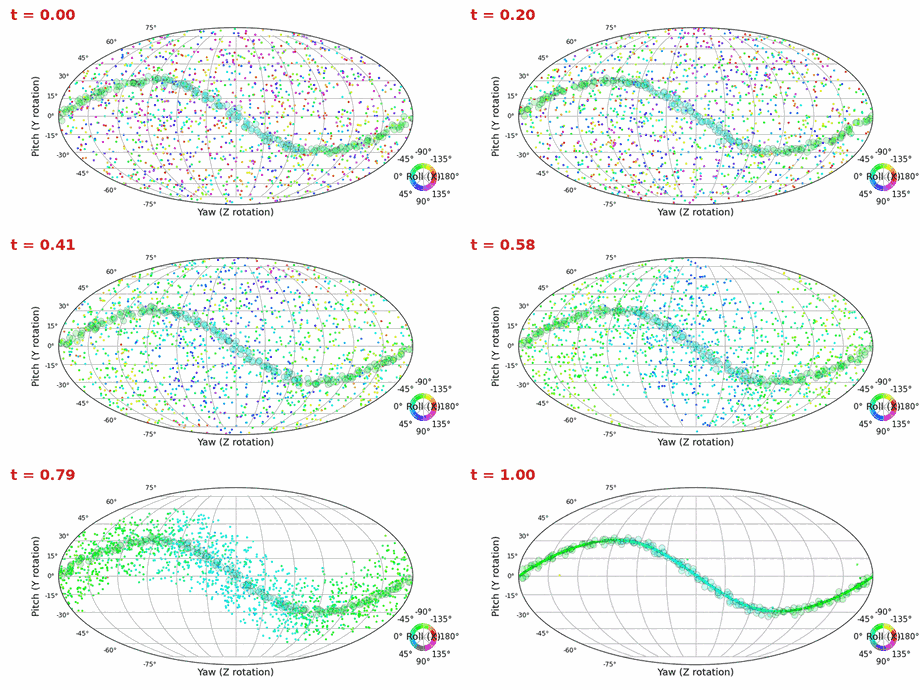
On synthetic 3D point clouds, we visualize the learned symmetry distribution by generating $\mathrm{SO}(3)$ elements and plotting their Euler angles on a Mollweide projection (gray-bordered circles are ground truth). The distribution concentrates on the true subgroup as the flow runs, with sharp clusters for discrete groups and a continuous ring for $\mathrm{SO}(2)$. The icosahedral group is also recovered correctly with the proposed power-law time schedule.

SO(3) to tetrahedral

Tetrahedral

SO(3) to octahedral

Octahedral

SO(3) to icosahedral

Icosahedral

SO(3) to SO(2) about the z axis

$\mathrm{SO}(2)$, $z$-axis

SO(3) to SO(2) about a tilted axis

$\mathrm{SO}(2)$, tilted axis

ModelNet10

On rotated ModelNet10 objects (real-world shapes), LieFlow achieves the lowest Wasserstein-1 distance $W_1$ on both discrete and continuous groups, beating LieGAN, SGM, and Augerino. Values are $W_1$ with relative improvement over random in parentheses; hypothesis group $\mathrm{SO}(3)$, averaged over 3 seeds; best per column in bold.

Method $\mathrm{SO}(3)\to\mathrm{Tet}$ $\mathrm{SO}(3)\to\mathrm{Oct}$ $\mathrm{SO}(3)\to\mathrm{SO}(2)$ ($z$) $\mathrm{SO}(3)\to\mathrm{SO}(2)$ (tilt) $\mathrm{SO}(3)\to\mathrm{Ico}$
LieGAN 1.113 (-23.5%) 1.145 (-59.8%) 0.101 (93.6%) 0.072 (95.4%) 0.893 (-72.2%)
SGM 0.915 (-1.5%) 0.742 (-3.6%) 1.848 (-17.2%) 1.832 (-16.2%) 1.031 (-98.8%)
Augerino 1.059 (-17.5%) 1.083 (-51.2%) 1.236 (21.6%) 1.244 (21.1%) 0.795 (-53.3%)
LieFlow 0.149 (83.5%) 0.097 (86.5%) 0.050 (96.8%) 0.053 (96.6%) 0.129 (75.1%)

Real-world: MI-Motion

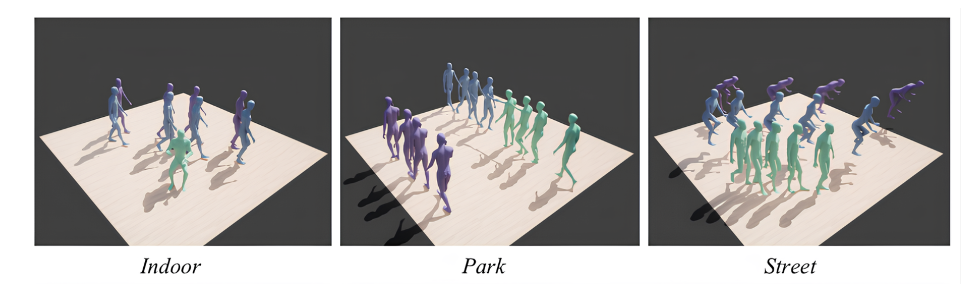
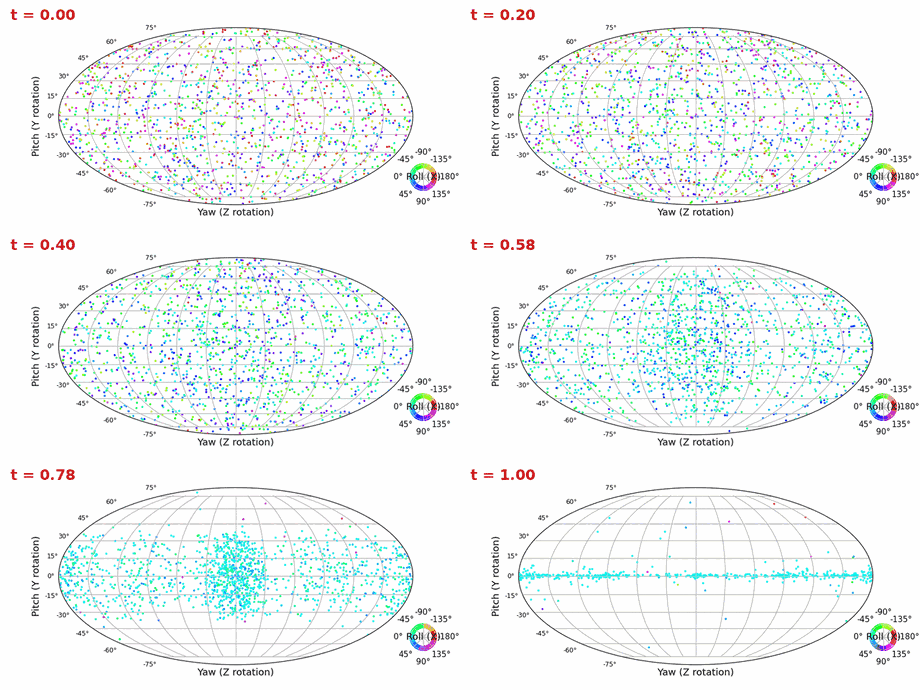
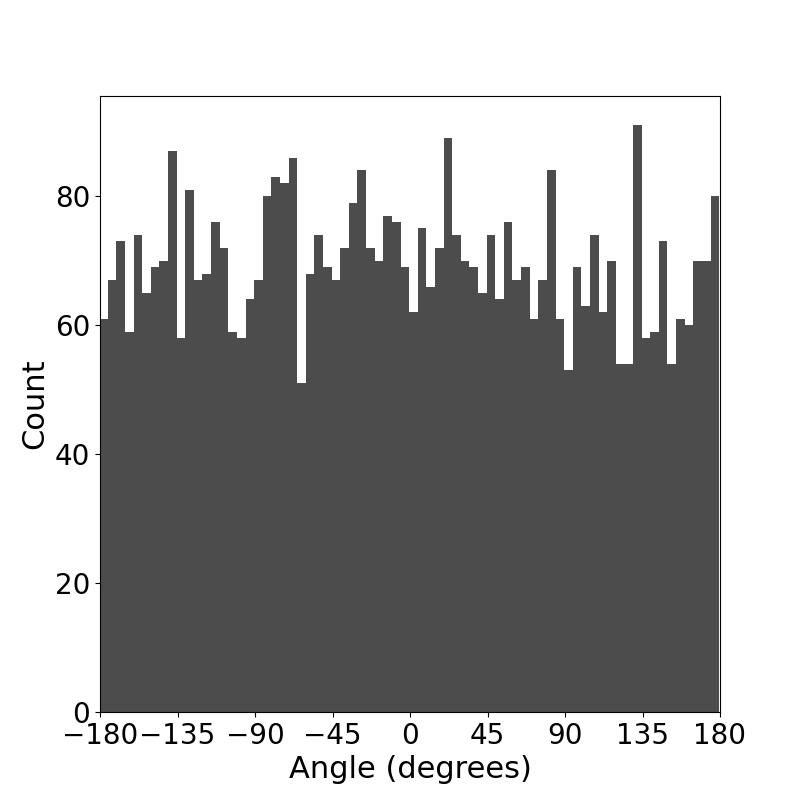
We further experiment on real human motion-capture data (people moving in indoor, park, and street scenes) without imposing a target group. LieFlow recovers the approximate $C_4$ symmetry about the vertical axis: the generated $\mathrm{SO}(3)$ elements concentrate on $z$-axis rotations and the angle histogram peaks at $0^\circ, 90^\circ, 180^\circ, 270^\circ$, while LieGAN collapses to a near-uniform distribution.

MI-Motion dataset: indoor, park, and street human motion scenes
Discovered SO(3) elements for MI-Motion

Discovered $\mathrm{SO}(3)$ elements concentrate on $z$-axis rotations.

MI-Motion LieFlow z-axis angle histogram

LieFlow (ours)

MI-Motion LieGAN z-axis angle histogram

LieGAN

BibTeX

@inproceedings{chen2026lieflow,
  title     = {Discovering Symmetry Groups with Flow Matching},
  author    = {Chen, Yuxuan and Park, Jung Yeon and Eijkelboom, Floor and Yang, Jianke and van de Meent, Jan-Willem and Wong, Lawson L.S. and Walters, Robin},
  booktitle = {Proceedings of the 43rd International Conference on Machine Learning (ICML)},
  year      = {2026},
}